
Concrete Spalling Repair: Matching the Method to the Cause
Most failed spalling repairs are not bad workmanship. They are the right method applied to the wrong cause.
Concrete spalling is not a single problem with a single fix. It is a description of damage, and that damage has at least six distinct causes. Each one calls for a different repair. Patch a delaminated floor the way you would patch a corroding balcony soffit and it will fail. Patch concrete affected by alkali-silica reaction and it will fail no matter how well the patch is built, because the thing driving the damage is still sitting in the surrounding concrete.
So the first question on a spalling repair is never "how do we fix it". It is "what caused it", and then "what does that cause require".
This guide covers the causes you will actually encounter in Sydney buildings, how to tell them apart, and what repair each one needs. If you are still working out whether what you are looking at is concrete cancer or something more benign, start with our guide on telling concrete spalling and concrete cancer apart, then come back here.
Why method selection matters more than method
The cost of a spalling repair is dominated by access, not by materials. On a facade, scaffolding, swing stages or an elevated work platform can account for a third to a half of the project. On a carpark deck, it is the traffic management and the loss of parking bays. In an occupied building, it is the owner time, the notices, the noise windows and the disruption.
That changes the economics completely. The materials in a wrong repair might be a few thousand dollars. Going back to do it again, with the same access set up a second time, is the real cost. It is also the cost that owners corporations find hardest to explain to members who were told the problem was solved.
This is why diagnosis is not a formality to get through before the real work starts. It is the part of the job that determines whether the money is well spent.
Cause 1: Reinforcement corrosion
This is the most common cause of spalling in Sydney residential and commercial buildings, and the one most people mean when they say concrete cancer.
Steel inside concrete is protected by the alkalinity of the concrete around it, which holds a passive film on the bar. Two things break that protection. Carbonation, where carbon dioxide gradually neutralises the concrete from the surface inward. And chlorides, which in coastal Sydney arrive as airborne salt and reach the steel through cracks and porous concrete. Once the protection is gone, the steel corrodes, the corrosion products occupy more volume than the steel they replaced, and the concrete is pushed off from the inside.
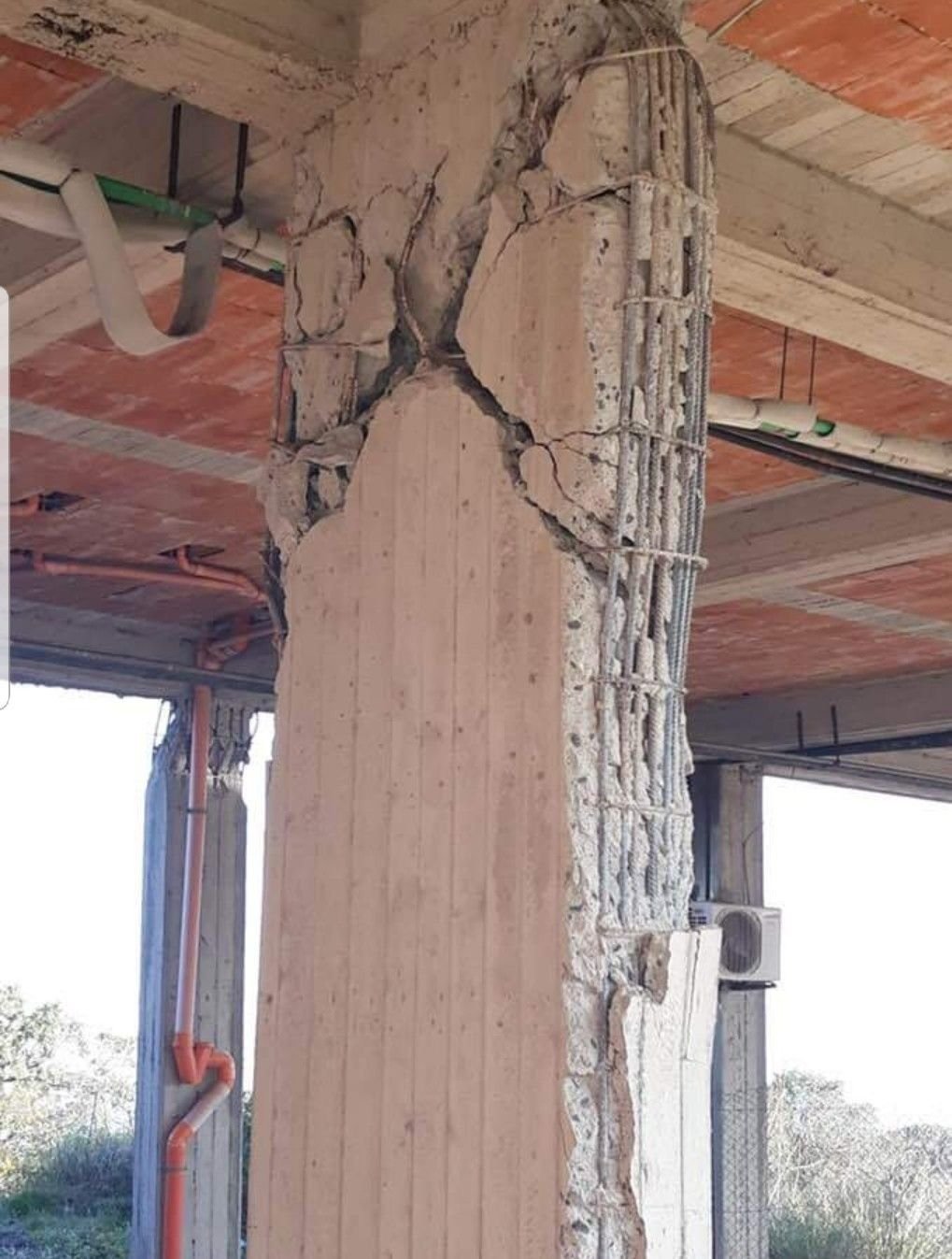
What it looks like: rust staining, cracks running in straight lines that follow the reinforcement below, hollow sounding concrete around the damage, and exposed steel once a piece falls away. It concentrates at balcony edges, soffits, slab edges and anywhere cover is thin.
What the repair requires: removal of concrete back past the bar rather than up to it, cleaning or replacement of the steel, reinstatement with a compatible repair material, and treatment of whatever is letting water in. It also usually requires galvanic anodes at the repair perimeter, because a patch repair on its own creates fresh corrosion in the concrete immediately around it.
That process has enough detail to warrant its own guide. We have written it up in full in how concrete cancer repair is actually done, including the breakout rule, material selection and why repairs fail.
The critical point for this article is simply that corrosion spalling is the one cause where the steel is the problem. Every other cause on this list is about the concrete itself.
Cause 2: Surface delamination from finishing
This one gets misdiagnosed as concrete cancer constantly, and the repair bills that follow are far larger than they need to be.
When concrete is placed, water rises to the surface as bleed water. If the surface is closed up by power trowelling before that bleeding has finished, the densified skin traps water and air underneath it. What you get is a thin surface layer, usually around 3mm to 6mm, sitting on a weak plane. Months or years later that layer lifts off in sheets.
The conditions that cause it are all about the surface stiffening faster than the concrete below can finish bleeding. Wind, direct sun, low humidity, a cold subgrade, a vapour barrier directly beneath the slab, an over-consolidated surface or a retarded mix will each push it that way.
What it looks like: thin flakes or sheets rather than chunks. No rust staining. No exposed steel, because the separation is nowhere near the reinforcement. Large areas sound hollow when tapped or chain dragged, often far beyond where anything has actually come off yet. You see it on trowelled floors, carpark decks, plant room slabs and topping slabs.
What the repair requires: the entire delaminated layer has to come off, not just the part that has already lifted. This is the step that gets skipped. A patch placed over an area that is still debonded around it will come away with the next sheet. The sound extent is established by sounding the whole slab, the loose layer is removed back to sound concrete, the surface is prepared to an appropriate profile, and the area is reinstated with a bonded patch or, where the extent is large, ground back and given a bonded overlay.
Done properly this is usually a cheaper repair than corrosion damage, because there is no steel work and no breakout depth. Done as a cosmetic fill it will be back within a year.
Fire-damaged concrete spalls through a completely different mechanism. Free water and chemically bound water in the concrete turn to steam, and because concrete is dense the steam cannot escape fast enough. Pore pressure builds and the surface comes off, sometimes explosively during the fire itself.
The repair question here is not the usual one. Concrete loses strength as it is heated, and above roughly 300 degrees that loss is permanent. So the issue is not how to patch the damage. It is how much structural capacity is left in the element, and how far into the section the heat went.
What the repair requires: assessment before anything else. That means establishing residual strength at depth, not at the surface, and determining whether the reinforcement reached temperatures that affected its properties. Depending on what that assessment finds, the outcome ranges from a conventional repair to strengthening to replacement of the element.
This is the cause where going straight to a repair contractor costs the most. Materials testing and diagnostics comes first, and the repair is specified from what it finds.
Cause 3: Fire damage
Cause 4: Impact and mechanical damage
Carpark columns clipped by vehicles, loading dock edges, kerbs, balcony nosings, slab edges damaged during a fitout. The cause is obvious and the repair is usually the most straightforward on this list.
What the repair requires: confirm that the damage is genuinely mechanical and has not simply exposed pre-existing corrosion. Check whether cracking has propagated beyond the impact point. Check whether reinforcement has been bent, cut or displaced, which turns a patch into an engineering question. Where the steel is sound and the damage is local, reinstatement with a suitable repair mortar is all that is needed.
Two cautions. First, repeated impact damage in the same location is a design or traffic management problem, and repairing it without addressing that guarantees a return visit. Second, once concrete has been broken away and steel exposed, that steel starts corroding, so "we will deal with it at the next maintenance cycle" quietly converts a simple repair into a corrosion repair.
Cause 5: Alkali-silica reaction
Alkali-silica reaction occurs when reactive silica in the aggregate reacts with alkalis in the cement in the presence of moisture. The reaction produces a gel that swells, and the expansion cracks the concrete from within.
It is much less common in Sydney than corrosion, but it matters because it is the one cause where ordinary patch repair is close to pointless.
What it looks like: map cracking, sometimes described as crazing but coarser and deeper, often with gel visible at crack faces. Pop-outs over individual aggregate particles. Damage that does not follow the reinforcement, which is the key difference from corrosion. It usually appears across a whole element or a whole pour rather than concentrated at edges and soffits.
What the repair requires: honest expectation setting first. The reaction is in the parent concrete, so removing damaged material and replacing it does not stop the surrounding concrete from continuing to expand. Management focuses on reducing moisture availability, since the reaction needs water to continue, and on monitoring expansion over time. Localised repair has a role in restoring cover and appearance, but it is maintenance, not a cure. For significantly affected elements, replacement is sometimes the only durable answer.
Getting this diagnosis wrong in either direction is expensive. Treating corrosion as ASR means doing nothing while steel keeps corroding. Treating ASR as corrosion means spending heavily on repairs that will crack again.
Cause 6: Chemical and sulfate attack
Industrial floors, plant rooms, wastewater structures, some commercial kitchens, and concrete in contact with aggressive soils or groundwater. Sulfates, acids and some process chemicals break down the cement paste itself rather than attacking the steel.
What the repair requires: the method is conventional, but the material selection is not. Repairing sulfate-attacked concrete with an ordinary repair mortar reproduces the failure, because the new material is just as vulnerable as the old. The binder has to suit the exposure, and in many cases the surface needs a chemically resistant protective system on top. The source of exposure also needs to be addressed where that is possible, through drainage, bunding or process change.
The cause that gets blamed in Sydney and almost never applies
A great deal of online material about concrete spalling blames freeze-thaw cycling. Water enters the concrete, freezes, expands, and breaks the surface apart over repeated cycles.
It is a genuine mechanism. It is also close to irrelevant on the Sydney coastal strip, which does not get the repeated freezing that drives it. Alpine NSW is a different matter, and so are some inland areas at altitude. But if you are looking at spalling on a Bondi or Manly balcony, freeze-thaw is not the explanation, and an assessment that offers it as one is being recycled from northern hemisphere sources rather than written for your building.
This matters more than it sounds. If a report misattributes the cause, the repair specification that follows is built on the wrong premise.
Insufficient cover: not a cause, but the reason it started early
Cover is the depth of concrete between the surface and the reinforcement. It is what gives carbonation and chlorides a distance to travel before they reach the steel, and it is the single biggest factor in how long an element lasts in a given environment.
AS 3600 sets exposure classifications that reflect this. B1 covers regular moisture without marine salt. B2 covers coastal environments with salt laden air but no direct spray. C1 and C2 cover direct marine exposure and tidal or splash zones, where chloride loading is severe. The cover required rises with the classification, and much of Sydney's coastal residential stock sits in B2 or harsher.
Where cover is deficient, you have a decision to make that a repair contractor cannot make for you. Reinstating the patch to the same thin cover means the same failure will repeat on the same timeline. The realistic options are to build the section out to achieve greater cover where geometry allows it, to apply a protective coating system that slows ingress, to install cathodic protection where the extent justifies it, or to accept a shorter service life and plan the next intervention into the capital works fund rather than being surprised by it.
That last option is legitimate, and it is sometimes the right commercial answer. It is only a bad outcome when nobody told the owners it was the option being taken.
Patch, overlay or replace
There is a point where repairing element by element stops making financial sense, and the signals are reasonably consistent.
Patch repair suits damage that is localised, where the sound concrete around it is genuinely sound, and where the total repair area is a modest proportion of the element. Once you are chasing damage across a large fraction of a slab or facade, the cost of repeated small repairs plus access exceeds the cost of a single comprehensive treatment.
Overlay or recoating suits widespread shallow damage, particularly delamination and surface deterioration, where the substrate below is intact and the structure is not in question.
Replacement becomes the answer when structural capacity is compromised, when the damage mechanism cannot be arrested, or when the repair cost approaches the replacement cost. Fire-damaged elements and heavily ASR-affected elements both end up here more often than corrosion damage does.
The honest version of this decision needs element by element quantities, not a percentage estimate, which is why the investigation matters.
Not all spalling is equally urgent
A hollow patch on a kerb and a hollow patch on a soffit above a building entrance are the same defect with completely different risk profiles. Concrete falling from height is a life safety matter, and it does not announce itself before it lets go.
Practical triage runs roughly like this. Spalling on soffits, balcony undersides, facade elements and anything overhanging an area people walk through is urgent, and the immediate action is to make it safe by removing loose material and establishing exclusion or protection, before any repair is scheduled. Spalling on columns and walls at ground level is serious but not an immediate falling hazard. Spalling on kerbs, plinths and non-structural elements can usually be programmed into normal maintenance.
Making something safe is not repairing it, and it is worth being clear with owners about that distinction. Removing loose concrete from a soffit removes the hazard. It does not stop the mechanism.
What a spalling investigation should give you
If you are commissioning an assessment, the output should let you specify and price the repair without further work. That means it identifies the cause rather than describing the symptom, establishes the extent by sounding rather than by what is visible, quantifies the repair areas element by element, states what testing was done and what it found, and sets out the repair methodology including materials and any protection required.
A report that says "concrete spalling was observed, repairs are recommended" has not done any of that, and you cannot tender from it. A report that distinguishes between the causes above, and tells you which one you have and why, is the thing that stops you paying for the wrong repair.
We cover what a competent assessment contains in more detail in our guide to building defect reports, and for facades specifically in facade inspections.
Frequently asked questions
How much does concrete spalling repair cost? It depends almost entirely on cause, extent and access rather than on area. Delamination on an accessible slab is at the low end. Corrosion damage on a facade requiring scaffolding and anode installation is at the high end, and fire or ASR damage can move into structural work. We set out the cost drivers and typical ranges for corrosion damage in our guide on what concrete cancer repairs actually cost.
Can I repair concrete spalling myself? Cosmetic surface damage on a non-structural element, yes. Anything where steel is exposed, where the element is structural, or where the cause has not been established, no. The risk is not a poor finish. It is sealing a corroding bar inside a patch and losing the warning signs while the mechanism continues.
How long should a spalling repair last? A correctly diagnosed and executed repair with the water source addressed should last decades. A repair that treats the symptom typically returns within two to five years, which is why so many owners feel that repairs do not work. Usually the repair worked. The diagnosis did not.
Does spalling always mean the building is unsafe? No. A great deal of spalling is durability damage rather than structural damage. But the only way to know which one you are dealing with is assessment, and spalling on anything overhead should be made safe immediately regardless of what the assessment later concludes.
Do I need an engineer, or can a repair contractor handle it? A contractor can execute a repair. Deciding which repair, on what extent, with what material, and whether the element still has the capacity it needs, is engineering. Where the cause is unclear, where the element is structural, or where you need a specification to tender from, you need an engineer. We explain where the line falls in remedial versus structural engineering.
What happens if we leave it? That depends on the cause. Corrosion is progressive and accelerates, so leaving it reliably costs more later. Delamination will continue to lift but will not threaten the structure. ASR will continue to expand. Impact damage will stay as it is unless steel is exposed, at which point it becomes corrosion damage. Only one of those is stable, and it is worth knowing which one you have.
Get the cause confirmed before you price the repair
Assentra assesses concrete spalling across residential, strata and commercial buildings in Sydney. We identify the cause rather than the symptom, quantify the extent by sounding and testing, and produce a repair specification you can tender from.
If repairs have already been carried out and the damage has returned, that is worth looking at too. It usually tells us something about the original diagnosis.
Get in touch to discuss an assessment, or read more about our building diagnostics and materials testing and engineered solutions.